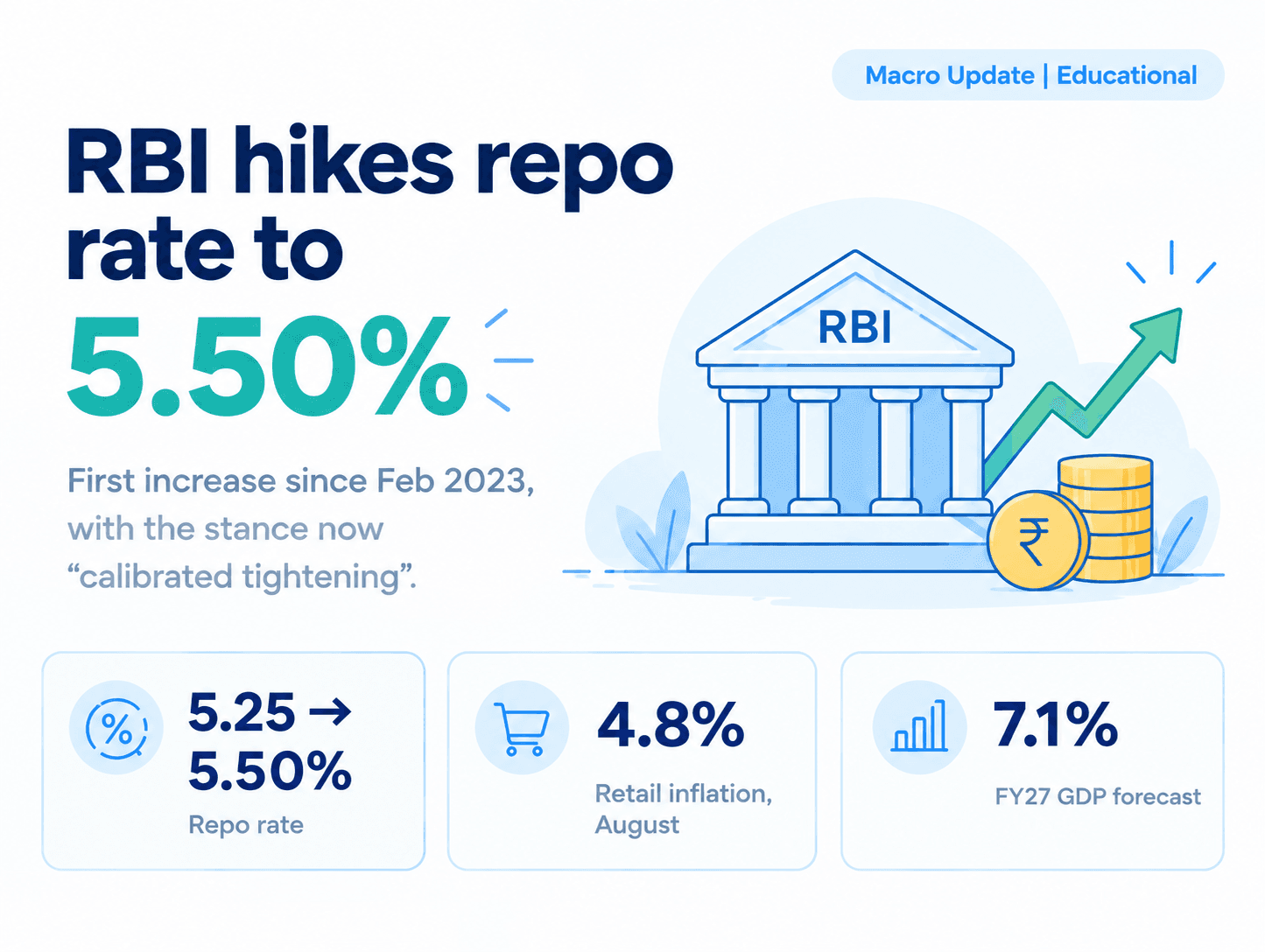
RBI Hikes Repo Rate to 5.50%, Signals Tightening Phase
The Reserve Bank of India has raised the repo rate by 25 basis points, from 5.25% to 5.50%, its first increase since February 2023. The standing deposit facility rate moves to 5.25%, and the marginal standing facility rate and Bank Rate to 5.75%.
The hike itself was largely priced in. The bigger shift is the stance, changed from "neutral" to "calibrated tightening". All six Monetary Policy Committee members backed the rate increase, but only four voted for the stance change. Governor Sanjay Malhotra said rate cuts are off the table in the near term. The stance leaves room to hike again or pause, depending on how inflation behaves.
Inflation is the trigger! Retail inflation rose to 4.8% in August from 4.45% in July, above the 4% target for a third month, with food inflation near 6%. Core inflation has also edged up to 4.2%, a sign that higher costs are reaching consumers.
Two supply shocks are driving it:
- Oil: Brent crude is around $100 a barrel, up about 40% since August on West Asia tensions.
- Monsoon: rainfall ended September, 13% below normal, the largest shortfall since 2015, with El Niño a risk to the rabi crop.
The RBI now projects FY27 inflation at 5.2%, peaking near 6.0% in October-December and staying at 5.7% and 5.6% in the following two quarters. Even after the hike, the 5.50% repo rate sits below that path.
The FY27 GDP forecast was raised to 7.1% from 6.7%, after 7.8% growth in April-June. The quarterly path eases from 7.2% to 6.9% and then 6.8%. With growth this strong, the RBI had little reason to delay.
Borrowers will see higher EMIs on floating-rate loans, while deposit rates should rise with a lag. Businesses, particularly MSMEs and retailers, face costlier working capital, though a single 25 bps move is unlikely to dent festive demand. NBFCs will feel pressure on margins wherever borrowings reprice faster than loans. For investors, higher rates raise the bar for valuations, favouring banks and financials over rate-sensitive sectors such as autos and real estate.
Indian equities have already priced in the rate hike, so the immediate market reaction was limited. FIIs remain selective on India, with heavy buying constrained by relative valuations versus other emerging markets and the impact of rupee depreciation on effective returns. The rupee has depreciated by around 7% in 2026 so far, adding another consideration for foreign investors.
If this situation remains the same and Brent holds above $100 till year-end, we could see an impact on the cost of borrowings for companies with upcoming capex plans. Debt-heavy businesses will also face higher interest servicing costs, which could lead to a contraction in margins and profitability.
The RBI is also draining surplus liquidity from heavy FCNR(B) inflows, net-absorbing an average ₹7.8 trillion in September, double August's level. Overnight rates still sit below the repo rate, so liquidity remains ample.
If Brent cools, one hike may be enough; if it stays high, the December meeting could bring another 25 bps. Credit growth is still expected at 14.5-15.5% this fiscal, a sign that demand can absorb higher rates.
Key dates:
12 October: September CPI data
Around 21 October: MPC minutes, which should explain the split on the stance
2-4 December: next MPC decision