Bank Check · Day 6 of 6. An investor's guide to capital adequacy: what CRAR and CET1 measure, how much capital is enough, and when more capital isn't better.
Over five days we followed a bank's money from start to finish: what it pays for deposits (CASA), what it earns on loans (NIM), what it loses to bad loans, what it spends to run, and what it finally returns (ROA and ROE). Today: the capital that stands behind all of it.
At 30 September 2026, one bank in our comparison held ₹21.40 of core capital for every ₹100 of risk-weighted assets. Another held ₹12.80. Both are well above the regulatory minimum of ₹8. Holding two-thirds more capital does not automatically make the first bank the stronger one. Here's how to read the number.
What capital adequacy measures
A bank lends mostly depositors' money. When loans go bad, the bank's own capital absorbs the loss first, before depositors are touched. Capital adequacy measures that cushion against how risky the bank's assets are.
The denominator is risk-weighted assets, not total assets. Riskier loans count for more; central government bonds carry no credit-risk weight. A 16% ratio means roughly ₹16 of capital for every ₹100 of risk-weighted assets.
Read four numbers together:
- CRAR = Total capital ÷ Risk-weighted assets. The whole cushion, including subordinated bonds that count as capital.
- CET1 = Equity and retained profit ÷ Risk-weighted assets. The strongest part of the cushion: money that absorbs losses without any repayment owed.
- The minimum. RBI requires commercial banks to hold 11.5% CRAR and 8% CET1, including a 2.5% capital conservation buffer. Systemically important banks hold a little more: an extra 0.40% of CET1 for HDFC Bank and 0.20% for ICICI Bank. Small finance banks must hold 15% CRAR.
- Headroom = Reported ratio − Minimum. The room a bank has to grow its loans or absorb a shock before it has to slow down or raise capital.
Capital adequacy across bank categories, Q2 FY27
Every bank in our comparison held well above its minimum. The real difference is quality: core capital ran from 12.8% to 21.4% of risk-weighted assets.

CRAR and CET1 as reported at 30 Sep 2026, 10 banks · sources at the end
Public sector banks carry the thinnest core capital, though both strengthened over the year. Small finance banks hold more capital, but they also face a higher minimum of 15%.
The securities quoted are for illustration only and are not recommendatory.
What the number actually tells you
The level matters less than its quality, its direction and what the capital is for. One bank per category, Q2 FY27:
- Public sector : stronger, not just bigger. CET1 rose to 14.44% from 12.75% a year earlier, up 1.69 points. Total CRAR rose less, to 17.95% from 17.19%. Subordinated bonds can lift CRAR; only equity and retained profit lift CET1.
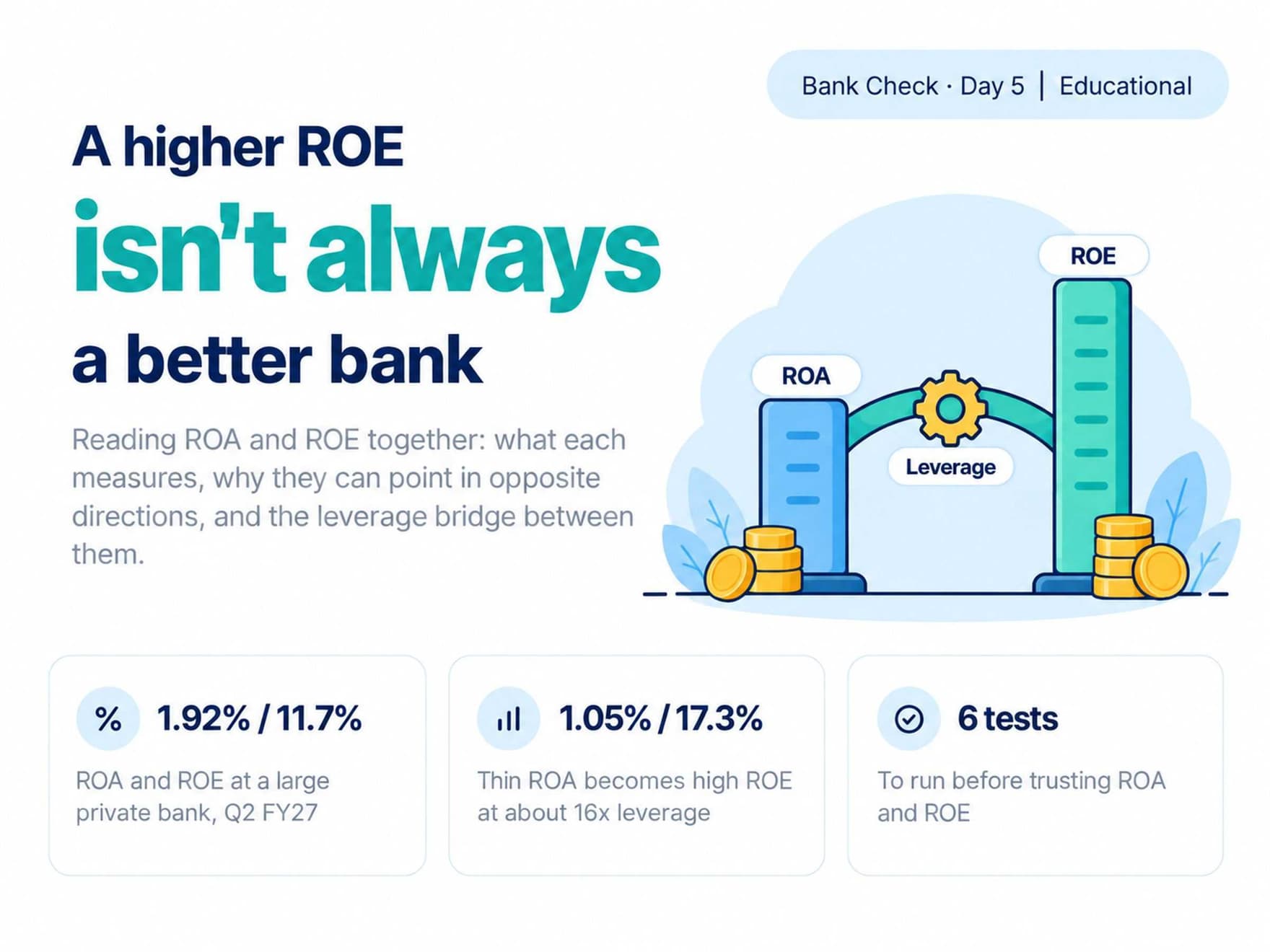
- Large private : more than it needs. Standalone CET1 of 21.4% is more than 2.5 times the 8% minimum. That spare capital is why its ROE of 11.7% (Day 5) trails a strong ROA. Idle capital is safe, but it drags returns until it is put to work.
- Mid-size private : capital being used up. CRAR slipped to 16.59% from about 17.1% a year earlier, while net advances grew 11.2%. When loans grow faster than retained profit, the cushion thins.
- Small finance : a higher bar. CRAR was 20.69% against a 15% minimum. Its board has approved a ₹409 crore share issue to IFC and three life insurers, priced above book value, which management says would add about 1.2 points.
More capital doesn't make a better bank. Ask what the capital is for, and which way it is moving.
The securities quoted are for illustration only and are not recommendatory.
Read it with ROE, and with what's coming
Capital and returns pull against each other. On Day 5, ROE was ROA multiplied by leverage. A bank that lends more against each rupee of its own capital lifts its ROE, but thins its cushion. A bank that holds a lot of capital is safer, but its ROE looks lower. Read a high ROE next to CET1 before giving it credit.
The next test is already scheduled. From 1 April 2027, RBI's expected credit loss (ECL) framework requires banks to provide for loan losses before they occur, not after. Crisil Ratings estimates a one-time net hit of about 120 basis points to banks' CET1 ratios. Fitch Ratings puts the cumulative impact closer to 80 basis points. Banks can spread it over four years.
The sector starts from a strong position, with CET1 of about 14% at 31 March 2026, according to Crisil. But the impact will vary by bank. Those with thin headroom, or more loans showing early signs of stress, will feel it most.
Six tests before you read a bank's capital
- Quality, not just size. Red flag: a healthy CRAR propped up mainly by subordinated bonds.
- Headroom. Red flag: a bank within a point or two of its minimum.
- Capital against growth. Red flag: CET1 falling quarter after quarter as loans race ahead.
- Against returns. Red flag: a high ROE that comes mainly from thin capital.
- Raises and dilution. Red flag: repeated share issues priced below book value.
- What's coming. Red flag: thin headroom going into the April 2027 loan-loss rules.
(A learning aid, not a recommendation.)
The takeaway: capital is what lets a bank take risk
Capital isn't idle money. It is what lets a bank take every risk behind the other five numbers in this series. Too little, and one bad year can force it to stop lending or raise money on poor terms. Too much, and its returns lag.
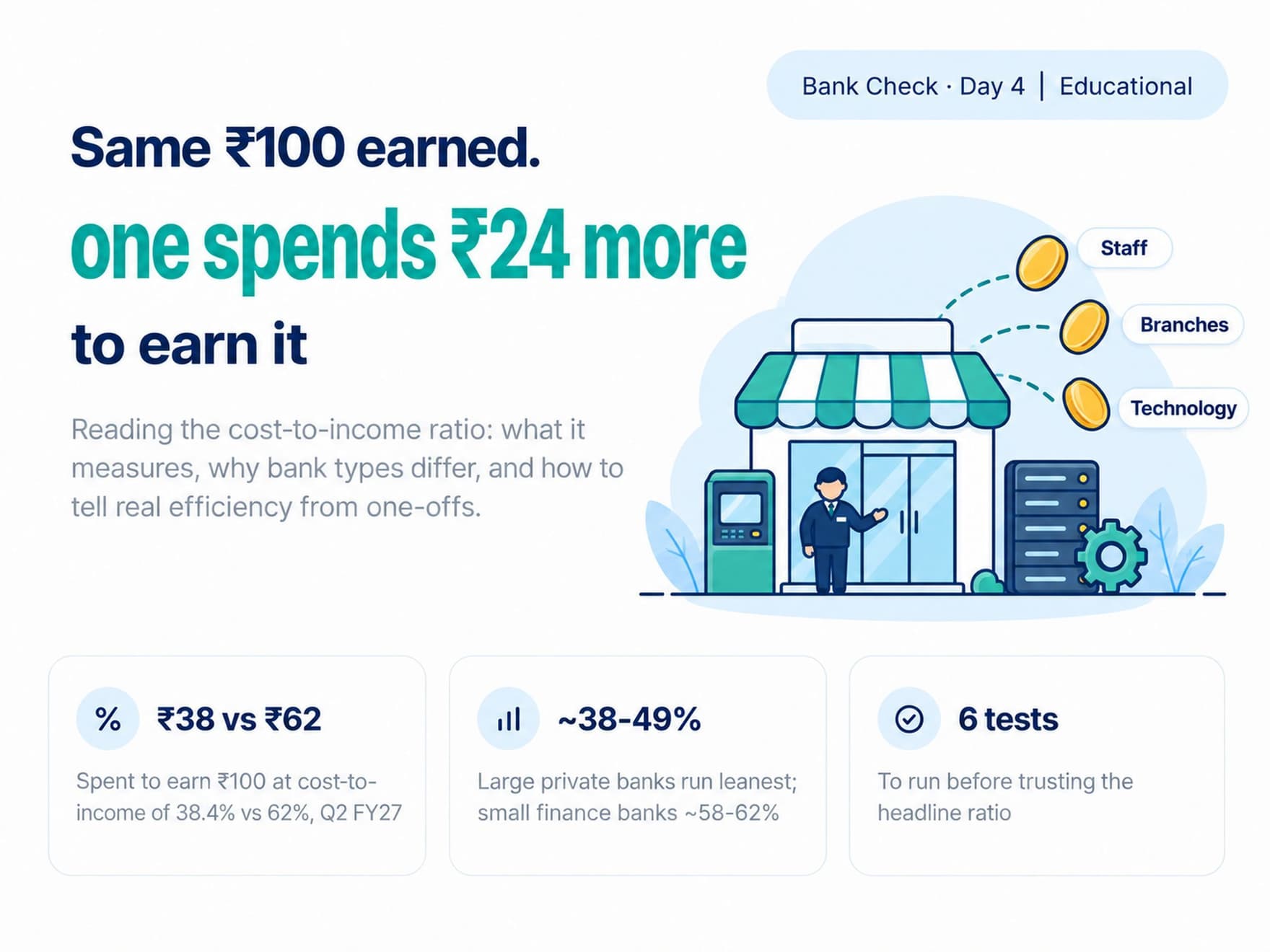
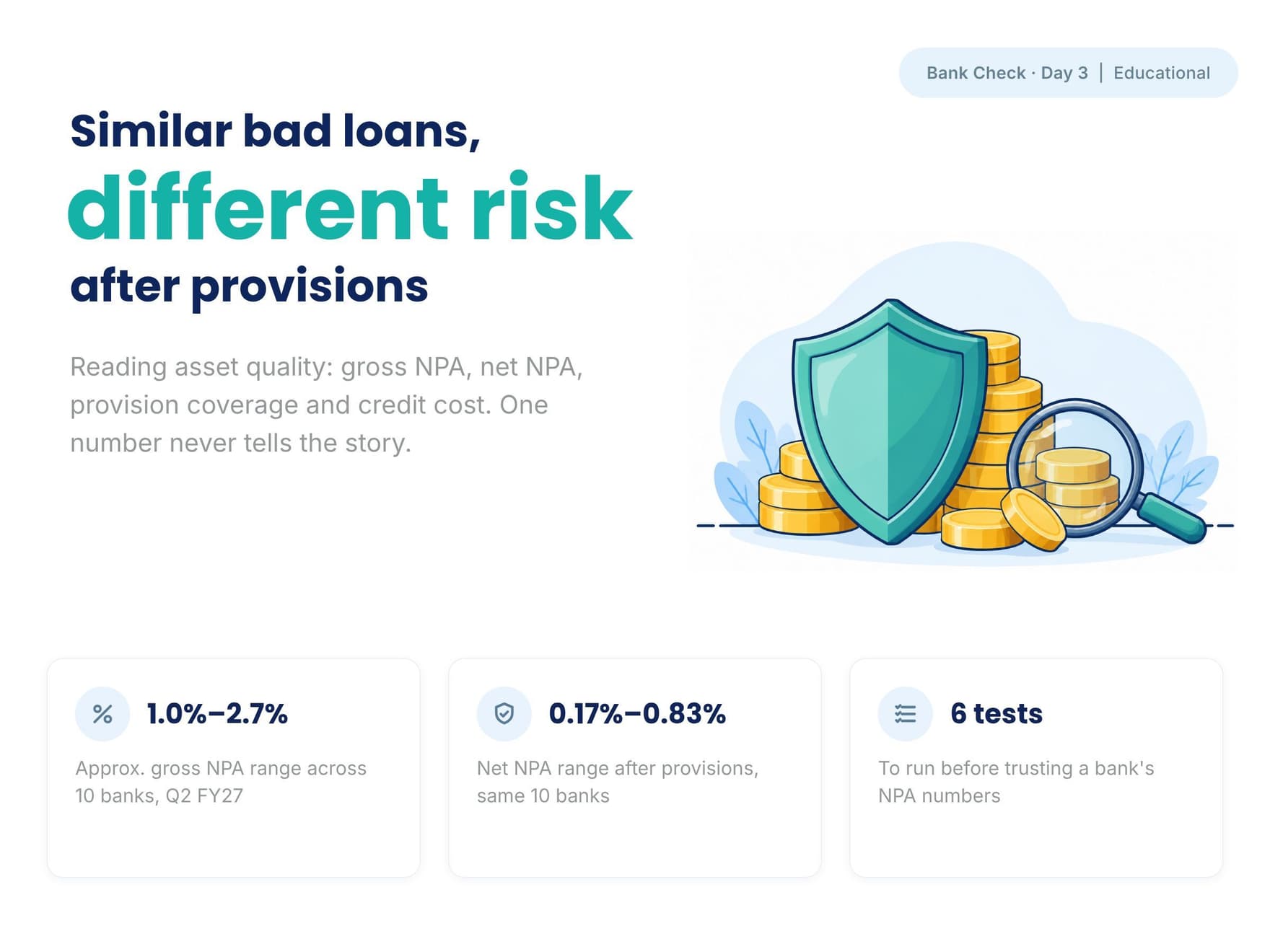
The full Bank Check chain: CASA sets what a bank pays for money. NIM shows what it earns. Credit cost and cost-to-income show what it loses and spends. ROA and ROE show what is left. Capital adequacy shows what it can survive. Run the next bank result you read through all six, in that order.
Frequently asked questions
What is a good capital adequacy ratio for an Indian bank?
RBI's minimum for commercial banks is 11.5% CRAR and 8% CET1, including the conservation buffer. In Q2 FY27, the banks in our comparison held between about 16% and 22% CRAR. What matters more is headroom over the minimum and the share that is CET1.
What is the difference between CRAR and CET1?
CRAR counts all regulatory capital, including subordinated bonds. CET1 counts only equity and retained profit, the capital that absorbs losses without any repayment owed.
Why do small finance banks need more capital?
They lend mostly small, often unsecured loans to borrowers with thinner credit histories. RBI requires them to hold at least 15% CRAR, against 11.5% for commercial banks.
How will the ECL framework affect bank capital?
From 1 April 2027, banks must provide for expected losses up front. Crisil estimates a one-time CET1 hit of about 120 basis points, which banks can spread over four years.